

Malaysia’s air defence capability could be seriously degraded if several key initiatives being pushed by the Royal Malaysian Air Force (RMAF) are blocked due to a lack of government funding.
At risk are three programmes – the proposed overhaul and mid-life update of the eight Boeing F/A-18D Hornets, the purchase of additional aircraft to supplement those Hornets, and the selection and acquisition of a new multirole combat aircraft (MRCA) to augment or replace the Sukhoi Su-30MKM Flankers.
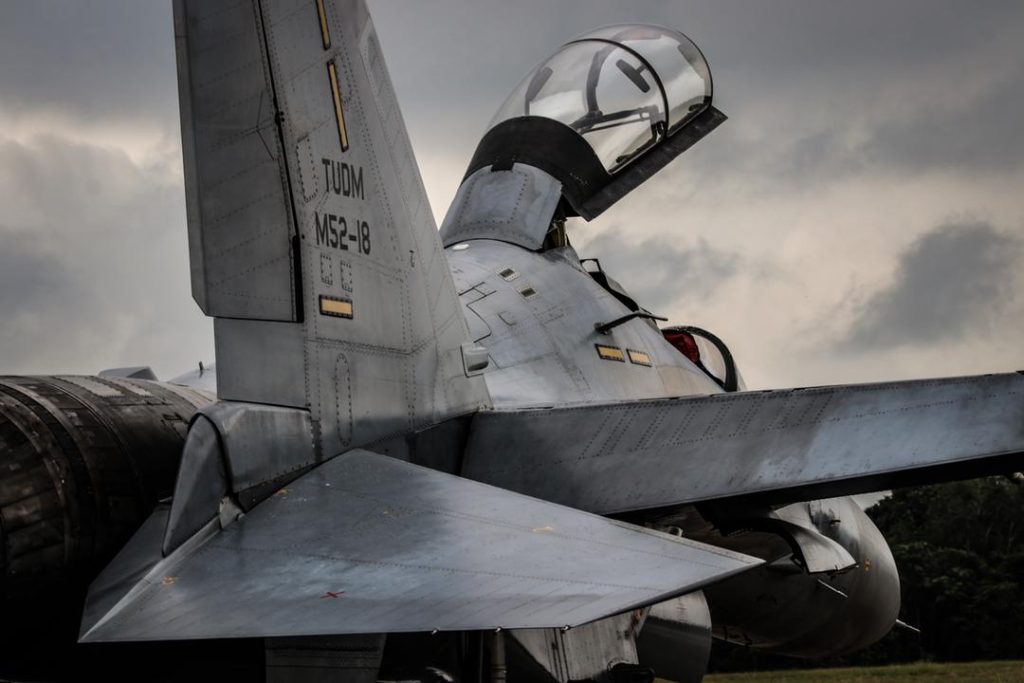
The Sukhoi Su-30MKM Flanker is RMAF’s long-ranged MRCA. A new platform is due to be selected soon to augment, or replace the type. The main image is the Boeing F/A-18D Hornet operated by No. 18 Squadron, based in RMAF Butterworth. Images by Syairazie Sabiyar
The biggest issue is funding. Malaysia has registered two consecutive quarters of negative growth, which puts it in a technical recession.
The ringgit has floundered against the greenback, hovering around 4.20 against the US dollar. As of last year, Malaysia’s national debt stood at US$225.74 billion. Covid-19, and more recently, the devastating floods, have added an additional strain to the nation’s finances.
“Our defence spending has hovered between RM14 billion and RM16 billion a year, and that amount is roughly evenly split between capital, and operational expenditure,” said a defence analyst who spoke to Twentytwo13 on condition of anonymity.
“The fact that the ringgit has weakened against the US dollar makes it even harder for Malaysia to maintain defence parity with potential adversaries.”
The analyst added that the RMAF’s fighter fleet has to undergo periodic upgrades to be able to counter more modern threats posed by 4.5 or 5th generation fighters being fielded in the region.
“These are aircraft with better avionics, sensor fusion, and radars that can acquire, track and engage targets faster. They’re also more manoeuvrable, and some have stealth characteristics.
“The air force is looking at a three-pronged approach to ensure that its fighter fleet stays relevant. But all this costs money.”
The first programme is divided into two phases. The first phase is the overhaul of the eight Hornets, under what is known as LPM12Y. This is on-going and involves a structural overhaul to extend the life of the airframes to 8,500 hours. This will allow the Hornets to fly until 2040.
“Phase two is a Mid-Life Update (MLU). This will be carried out after the LPM12Y is completed and will involve replacing older avionics with newer systems.
Twentytwo13 understands that this may include adding improved communications gear, radar homing and warning receivers, and a Link-16 datalink system.
At the top of the wish list would be the replacement of the old AN/APG-73 multimode radars with state-of-the-art Active Electronically Scanned Array (AESA) radar sets, such as the AN/APG-83 SABR or the AN/APG-79v4. The newer radars would enable Hornet crews to pick out targets quickly, and give them a “first look, first shot, first kill” capability.
These enhancements would bring the RMAF Hornets on a par with the more modern Boeing F/A-18E/F Super Hornet Block IIs, and improve their survivability in combat.
“The biggest worry is the MLU programme. This involves a huge investment, but is absolutely crucial to the warfighting capability and survivability of the type,” said the analyst.
“The government has to get its priorities straight. If the RMAF is not given funding for the MLU programme, its ability to counter more modern fighters will be seriously eroded.”
The second programme in the RMAF’s plan is to boost the number of fighters in its fleet. This is an interim solution, until the new MRCA comes online, between 2035 and 2040.
For this, the RMAF is looking to buy surplus ‘legacy’ Hornets – older F/A-18Cs and Ds from other air forces. Many are selling off their legacy Hornets as they re-equip with newer, and more potent, platforms.
On Dec 22, deputy Defence Minister Datuk Seri Ikmal Hisham Abdul Aziz told the Dewan Negara that Malaysia was interested in acquiring – “lock, stock and barrel” – 33 examples of the C and D versions of the Hornets belonging to the Kuwaiti Air Force (KAF). KAF had announced that it was replacing its legacy Hornets with Eurofighter Typhoons and Super Hornets.
However, on Dec 24, Kuwait denied conducting negotiations with Malaysia for the potential sale of its Hornets.
“No one is sure what the status is right now. There’s word that the Kuwaitis are considering an offer from Tunisia, or are not even planning to sell. They might want to build up their war stocks and keep their legacy Hornets in reserve as a second line of defence to augment their new Super Hornets and Typhoons,” said the analyst.
“This purchase is critical for Malaysia, when you consider the ‘militarisation’ of the South China Sea. The existing eight Hornets, plus the 18 Flankers, are not an effective enough deterrent against aggression.”
The third initiative that the RMAF is pushing, is the acquisition of a new multirole combat aircraft, either to supplement, or replace the Flanker.
“These aircraft are extremely capable, since they can perform a variety of tasks, like air-to-air, air-to-ground, anti-shipping, suppression of enemy air defences (SEAD), and strike/interdiction. That’s why they’re expensive.
“The Flankers are coming up to almost 15 years in service. Either way, the MRCA programme must be up and running before 2030. It takes about one to two years for a squadron to achieve full operational capability. The process has to start now.
“The prevalent thinking in government is that ‘These investments don’t bring in any returns’. That’s true… There’s zero ROI. But can we afford to sit and wait for the region to erupt in flames before we do anything?
“By then, it will already be too late.”


