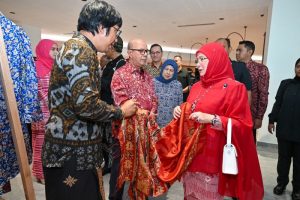

They headed to the rostrum one by one, representing various sectors across multiple industries, at a press conference organised by the Human Resources Ministry in Parliament this afternoon.
It seemed almost engineered as the select few representatives praised the Gig Workers Bill 2025, tabled for its first reading today. They also singled out Human Resources Minister Steven Sim, who stood beside them, and Prime Minister Datuk Seri Anwar Ibrahim.
Shouts of ‘Hidup Pekerja Gig‘ (Long live gig workers) echoed at the end of the press conference, which was attended by, among others, S. Karthigesan, co-chair of the Malaysian Bar’s Industrial & Employment Law Committee; Masrizal Mahidin, head activist of the Malaysian e-Hailing Coalition (GEM); Malaysia Trades Union Congress president Datuk Abdul Halim Mansor; and Lucy Lim, president of the Malaysian Sign Language Interpreters and Translators National Organisation.
The show of support was clearly aimed at sending a message to the handful of big industry players – companies that own no assets and rely on their so-called “partners”, the term they use to describe gig workers.
In fact, the ministry, via its official WhatsApp platform, has been disseminating press releases by organisations backing the Bill – including the Malaysian Sign Language Interpreters and Translators National Organisation; Malaysian Trades Union Congress Sarawak Division; Professional Film Workers Association of Malaysia; the Malaysian e-Hailing Coalition; and Karthigesan’s statement.
Most gig workers, including those outside the e-hailing sphere, believe the long-anticipated Bill marks a significant step towards regulating Malaysia’s booming gig economy. The proposed legislation aims to provide formal recognition and stronger protections for an estimated 1.2 million gig workers in the country.
Groups representing gig workers hailed the Bill as a crucial move to address years of regulatory gaps. Masrizal described it as a “game changer” and declared, “Our new chapter begins now”.
There were, however, murmurs from certain quarters that the Bill was being rushed and that the legislation could hurt smaller players. Some industry representatives claimed they had not seen the draft before its first reading and alleged the Bill was bulldozed so certain quarters could tick off their bucket list. Similar pushback has been seen with the Social Work Profession Bill, which has yet to reach the august House.
MY Mobility Vision chief executive officer Wan Agyl Wan Hassan, quoted by the New Sunday Times on Aug 24, said the intention of the Bill was noble, but its operational implications remained unclear. He warned that platform providers would ultimately pass compliance costs to consumers, leading to higher prices in an already challenging business environment, compounded by the rise in minimum wage, implementation of e-invoicing and the expansion of the Sales and Services Tax.
Grab Malaysia reaffirmed its commitment to work with stakeholders to ensure regulations governing the gig economy are carefully crafted to reflect the realities of gig work. In a statement on Aug 21, it stressed that regulations should be sustainable and not rushed.
The company cautioned that excessive rules could stifle innovation, disrupt operations and limit gig opportunities. It added that smaller players may also struggle with high compliance costs, while a one-size-fits-all policy would not suit the effort-based nature of gig work.
Sim, at today’s press conference, insisted the new law was not written in the comfort of air-conditioned rooms in Putrajaya. He said numerous discussions were held between ministries and government agencies, as well as 40 sessions involving platform providers, workers’ representatives, unions and NGOs, with some 4,000 people participating.
“We also allowed feedback online and received 500 submissions. After going through all views, we came up with this Bill,” Sim said.
He outlined four main items in the Bill:
- Definition of a gig worker
- Grievance mechanism
- Payment issues
- Social security
Sim referred to the aircraft crash in Elmina, Shah Alam, Selangor in August 2023 that killed 10 people, including an e-hailing driver and a p-hailing rider.
“One of the victims had continued paying his Social Security Organisation (Socso) contribution and following his death, his next-of-kin now receives a monthly pension of about RM1,800. The other victim, however, did not contribute, and so the family received nothing.”
Socso’s Survivors’ Pension is payable to eligible dependants of an insured person who dies, regardless of the cause of death not being work-related.
Sim said the disparity in outcomes for the families highlighted the absence of a formal structure for the industry and gig workers.
“I hope after this, we will get to read it for the second and third time. This Bill was not made out of thin air, not in fantasy. It was made after getting feedback from all parties and not to satisfy one side only,” he said.
Sim also called on Members of Parliament to support the Bill.